In the world of online payments, security is not just a feature—it's the foundation of trust. For high-risk merchants in industries like adult entertainment, forex, gaming, or CBD, the stakes are even higher.
A single data breach or a wave of fraudulent transactions can lead to massive fines, immediate account termination (MATCH list), and a total loss of reputation. Traditional banks already view these industries with suspicion; any security lapse confirms their bias.
1. Why Security Matters in High-Risk Payment Processing
High-risk merchants are disproportionately targeted by fraudsters, chargeback abusers, and regulatory scrutiny. The processor you choose is not just a payments vendor—it becomes your first line of defense against all three.
Security in this context is multi-dimensional: it spans cardholder data protection, transaction authentication, infrastructure hardening, and the financial security of your settled funds. Weakness in any layer can shut down an otherwise healthy business overnight.
2. Understanding PCI DSS Compliance
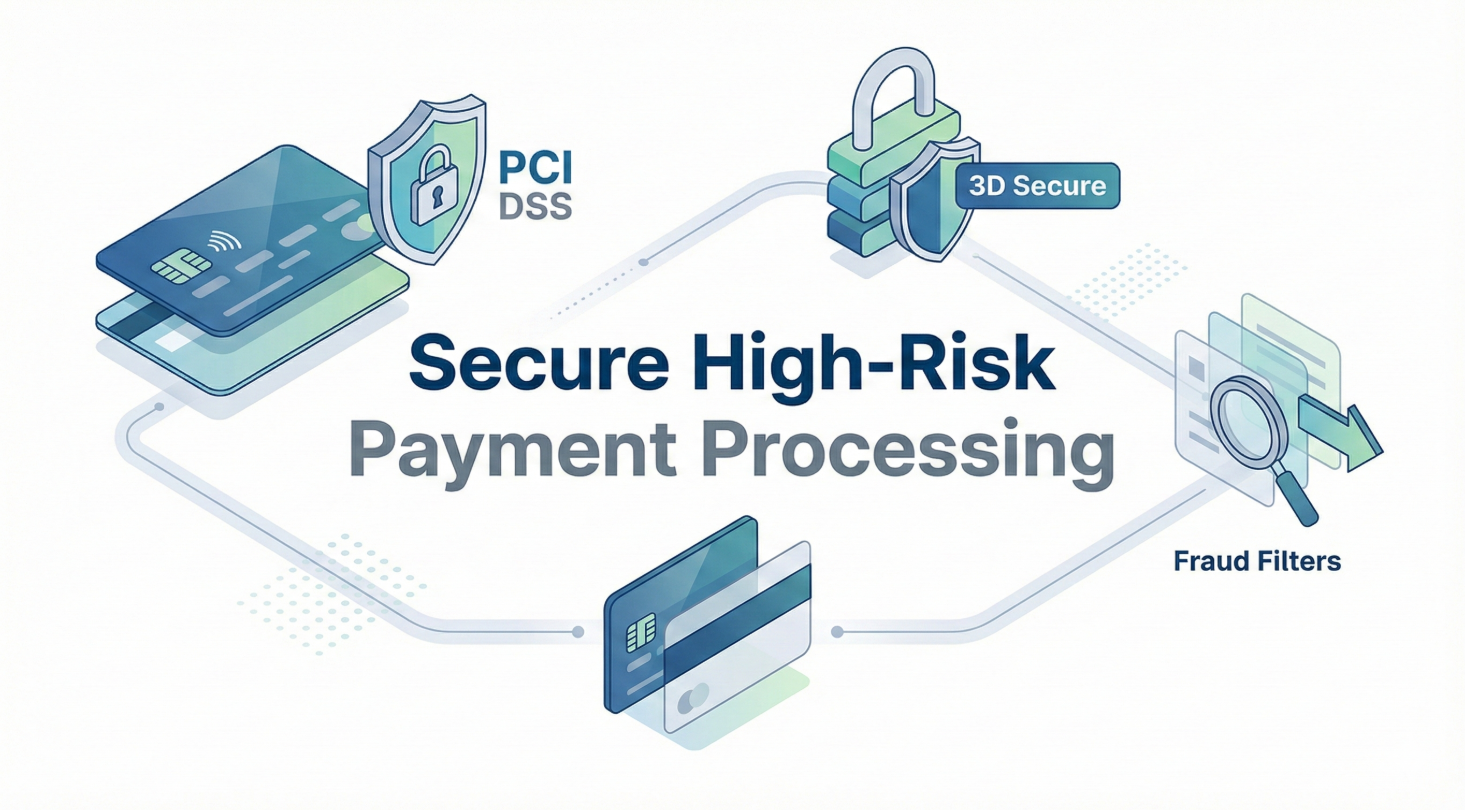
The Payment Card Industry Data Security Standard (PCI DSS) is a set of security standards designed to ensure that all companies that accept, process, store, or transmit credit card information maintain a secure environment.
The Challenge: Achieving full PCI compliance as a merchant is expensive and technically complex.
The Solution: Chain2Pay significantly reduces your compliance burden. When you use our hosted payment pages or tokenized API, the sensitive card data never touches your servers. We handle the heavy lifting, ensuring specific PCI obligations are met on our secure infrastructure.
3. 3D Secure, AVS, and Fraud Filters
To combat fraud effectively, you need a multi-layered defense system. Chain2Pay implements the following protections by default:
3D Secure (3DS)
3DS adds an extra layer of authentication. When a customer pays, they must verify their identity with their bank (e.g., via biometric scan or SMS code). This protocol is crucial because it triggers a liability shift: if a transaction is 3DS authenticated, the bank, not the merchant, is liable for fraud-related chargebacks.
Address Verification System (AVS)
AVS compares the numeric portion of the customer's billing address and zip code against the information on file with the card issuer. A mismatch is a strong indicator of stolen card usage.
4. Transaction Monitoring and Risk Management
Static rules are not enough. Sophisticated fraudsters use "clean" proxies and stolen identities. That's why dynamic monitoring is essential.
- Velocity Checks: We monitor the speed of transactions. Ten orders from the same IP in one minute? Blocked instantly.
- BIN Analysis: We analyze the Bank Identification Number to detect cards from high-risk jurisdictions or prepaid cards often used for fraud.
- Behavioral Analytics: AI-driven analysis of user behavior during checkout to spot anomalies.
5. Best Practices for High-Risk Merchants
Security is a shared responsibility. Here is how you can further harden your business:
- Use HTTPS Everywhere: Ensure your entire site is encrypted with SSL/TLS.
- Require Strong Passwords: If your users have accounts, enforce complexity requirements to prevent account takeovers.
- Clear Descriptors: Reduce "friendly fraud" by ensuring your billing descriptor matches your brand name clearly.
- Keep Software Updated: If you use WordPress/WooCommerce, keep your plugins and themes patched to prevent backdoor exploits.
6. Secure Integration Methods (APIs, SDKs)
How you integrate determines your security risk profile. Chain2Pay offers secure integration paths:
Hosted Payment Page (Safest)
Redirect the user to our secure checkout page. You never touch the card data. This is the easiest way to be PCI compliant.
Server-to-Server API (Flexible)
For merchants who need full control over the UI, our API supports secure tokenization. You collect the card data in a secure iframe, receive a token, and send only the token to your server.
API Response Example
// POST https://chain2pay.cloud/api/v2/payments
// Headers: { 'x-api-key': 'sk_live_...' }

{
  "success": true,
  "payment_url": "https://checkout.chain2pay.cloud/pay.php?address=0x123...",
  "order_id": "C2P-1741380553-a7f3c9e1b2d4f6a8"
}
Our API handles the complexity securely. You simply redirect the customer to the payment_url, where we handle the 3DS authentication and secure processing.
7. Handling Chargebacks Securely
Even with perfect security, disputes happen. Handling them securely means maintaining detailed logs.
Chain2Pay provides extensive transaction metadata (IP address, device fingerprint, AVS result, 3DS authentication status). Securely storing and retrieving this data allows you to win representment cases by proving the customer authorized the transaction.
And because settlements are made directly on-chain in USDC, a successful chargeback at the card layer cannot claw back funds from your wallet—the dispute happens upstream, not against your merchant balance.
8. Data Privacy & Encryption
We believe in privacy by design. While we process card payments securely:
- Data Minimization: We only request the data necessary to process the payment.
- Encryption at Rest: All sensitive data stored in our databases is encrypted using AES-256 standards.
- Crypto Settlement: We settle funds to your non-custodial wallet in USDC. This ensures that your revenue is secure on the blockchain, protected by private keys that only you control.
9. Frequently Asked Questions
Is Chain2Pay PCI Compliant?
Yes, our infrastructure adheres to strict PCI DSS level 1 standards to ensure the safety of all cardholder data.
Do I need an SSL certificate?
Absolutely. An SSL certificate (HTTPS) is mandatory for any website accepting payments or collecting user data.
Is my wallet address visible publicly?
Blockchain transactions are public, but your identity is not linked to your wallet address unless you publicly disclose it. This offers a layer of financial privacy for merchants.
How do you protect my API keys?
API keys should be stored server-side only and never exposed in client-side code. You can rotate `sk_live_...` keys instantly from your dashboard if one is ever compromised.
10. Conclusion
Security in high-risk payment processing is a continuous battle against evolving threats. By partnering with a gateway that employs state-of-the-art security measures like 3D Secure, AI monitoring, and encrypted infrastructure, you protect your business, your customers, and your bottom line.
Chain2Pay offers this level of security instantly, with no complex setup. Secure your payments today and focus on growing your business.